Acoustic Luminaires & Sound Dampening Illumination
A comprehensive study of dual-purpose luminaires engineered in Belgium to solve modern architectural acoustic challenges while delivering certified glare-free task illumination.
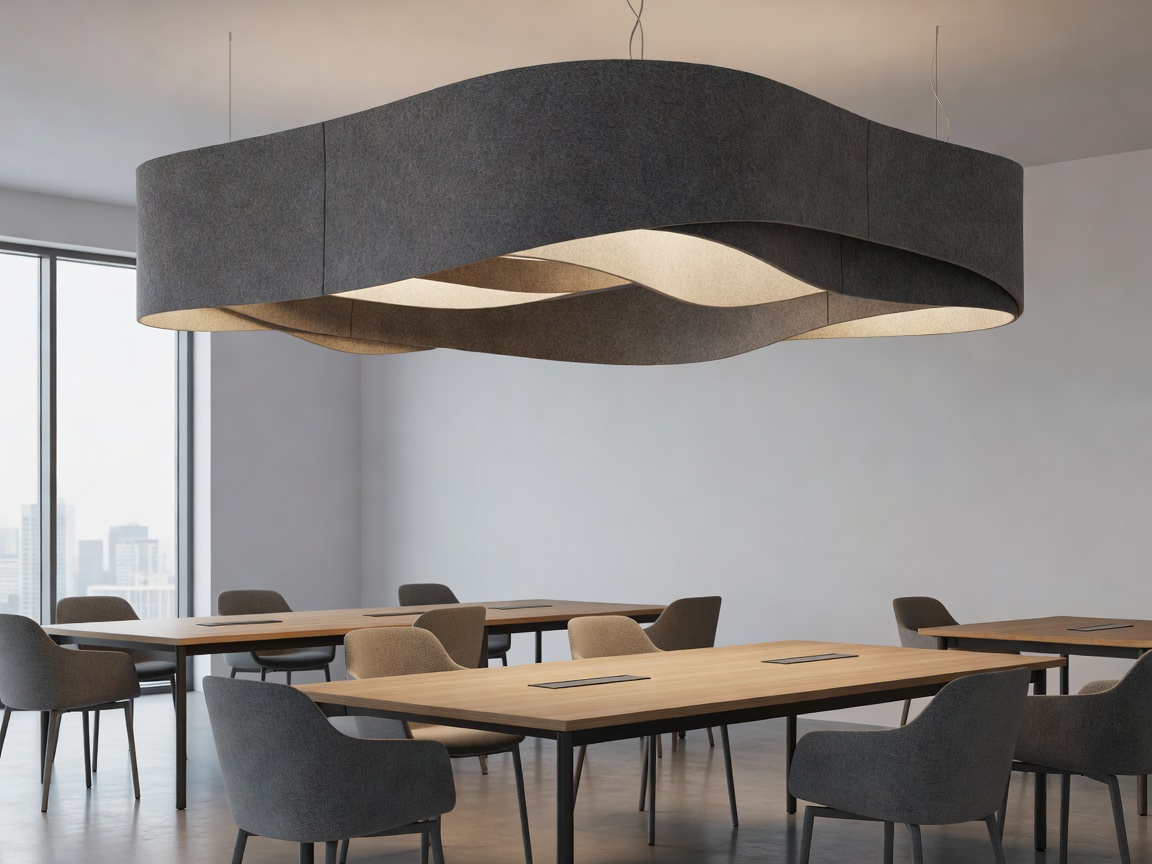
The Open-Plan Dilemma: Hard Surfaces and Echo
Contemporary European architecture heavily favors polished concrete floors, floor-to-ceiling glass curtain walls, and exposed steel frameworks. While visually expansive and structurally honest, these hard reflective materials create harsh acoustic environments. Reverberation times (RT60) often exceed 1.2 seconds in open-plan offices and high-end restaurants, resulting in the "cocktail party effect" where occupants must elevate speech levels to be understood.
Belgian designers recognized that the ceiling plane represents the single largest unobstructed surface area available to intercept sound waves. Rather than cluttering ceilings with separate acoustic baffles and standalone downlights, Belgian studios engineered integrated acoustic luminaires—marrying porous sound-dampening structures with precision optical engines.
Material Science: Recycled PET Felt and Wool Blends
The acoustic efficacy of these fixtures depends on porous absorption mechanisms. When sound waves encounter the fibrous network of thermoformed felt, air particles within the pores vibrate. Viscous friction converts acoustic kinetic energy into microscopic amounts of heat, substantially mitigating reverberation.
Belgian manufacturers primarily specify high-density thermoformed felt fabricated from up to 70% post-consumer recycled PET bottles, or dense natural Belgian wool felt. These materials achieve Noise Reduction Coefficients (NRC) between 0.70 and 0.90 according to ISO 354 testing standards, targeting the critical human speech frequency range between 500 Hz and 2,000 Hz.
Optical Precision: Achieving UGR < 16 in Work Environments
Integrating high-power LED arrays inside non-metallic felt bodies presents two engineering hurdles: heat dissipation and glare. Because felt acts as a thermal insulator, the optical module must be mounted in an independent extruded aluminum chassis acting as a heat sink, thermally decoupled from the acoustic body.
To satisfy stringent European workspace regulations (EN 12464-1), acoustic luminaires utilize dark-light micro-reflectors. Each LED diode sits recessed behind a parabolic metallized or deep-matte louver, yielding a Unified Glare Rating (UGR) below 16 and maintaining a minimum illuminance of 500 lux across the work plane with zero screen glare.
| Acoustic Luminaire Form | NRC Rating | Equivalent Sound Absorption Area (Aeq) | Luminous Flux | Target Space |
|---|---|---|---|---|
| Circular Dome (Ø 1200 mm) | 0.85 NRC | 1.85 m² Sabin at 1000 Hz | 3,200 – 4,800 lm | Round boardroom tables, restaurant booths |
| Linear Felt Baffle (2000 mm) | 0.80 NRC | 1.40 m² Sabin at 1000 Hz | 2,800 – 4,200 lm | Bench desking arrays, collaborative work zones |
| Sculptural Wave Canopy | 0.90 NRC | 2.60 m² Sabin at 1000 Hz | 5,400 – 7,200 lm | Open-plan atriums, co-working lounges |
Specification Trade-offs: Comparing Combined vs. Split Solutions
Specification Benefits
- Ceiling Decluttering: Eliminates duplicate ceiling penetrations, suspension cables, and junction boxes.
- Targeted Acoustic Treatment: Suspends absorption directly above conversation clusters at seated ear level (1.5 m–2.0 m).
- Certified Task Illumination: Meets EN 12464-1 criteria for office VDT tasks (UGR < 16, 500 lux on desk).
- Sustainable Substrates: Recycled PET felt is OEKO-TEX Standard 100 certified and recyclable at end of life.
Design Challenges
- Volumetric Scale: Acoustic felt surfaces must possess sufficient physical area to absorb sound; requires careful spatial balance in low ceilings.
- Cleaning Protocols: Porous felt surfaces attract airborne dust; requires periodic gentle vacuuming with soft-brush attachments.
- Coordination of Trades: Requires synchronized handover between electrical contractors and acoustic acoustic consultants.
Calculation Guidelines for Architects
When sizing an acoustic lighting installation, lighting designers work closely with acoustic engineers. Rather than simply calculating lumens per square meter, the team calculates the total Sabins of sound absorption needed to reduce reverberation time from e.g. 1.4 seconds down to the recommended 0.6 seconds for speech clarity. Sizing the quantity of circular acoustic pendants to simultaneously satisfy both lux levels and absorption targets yields an exceptionally cohesive architectural interior.
Optimize Room Acoustics and Lighting Together
Provide your room dimensions and finish schedules for a complimentary acoustic Sabin and photometric DIALux study.
Request Acoustic Simulation