Architectural Linear Profiles & Trimless Recessed Systems
An in-depth analysis of how Belgian manufacturers mastered trimless plasterboard channels, dark-light optical shields, and indirect cove extrusions to integrate light as pure structural form.
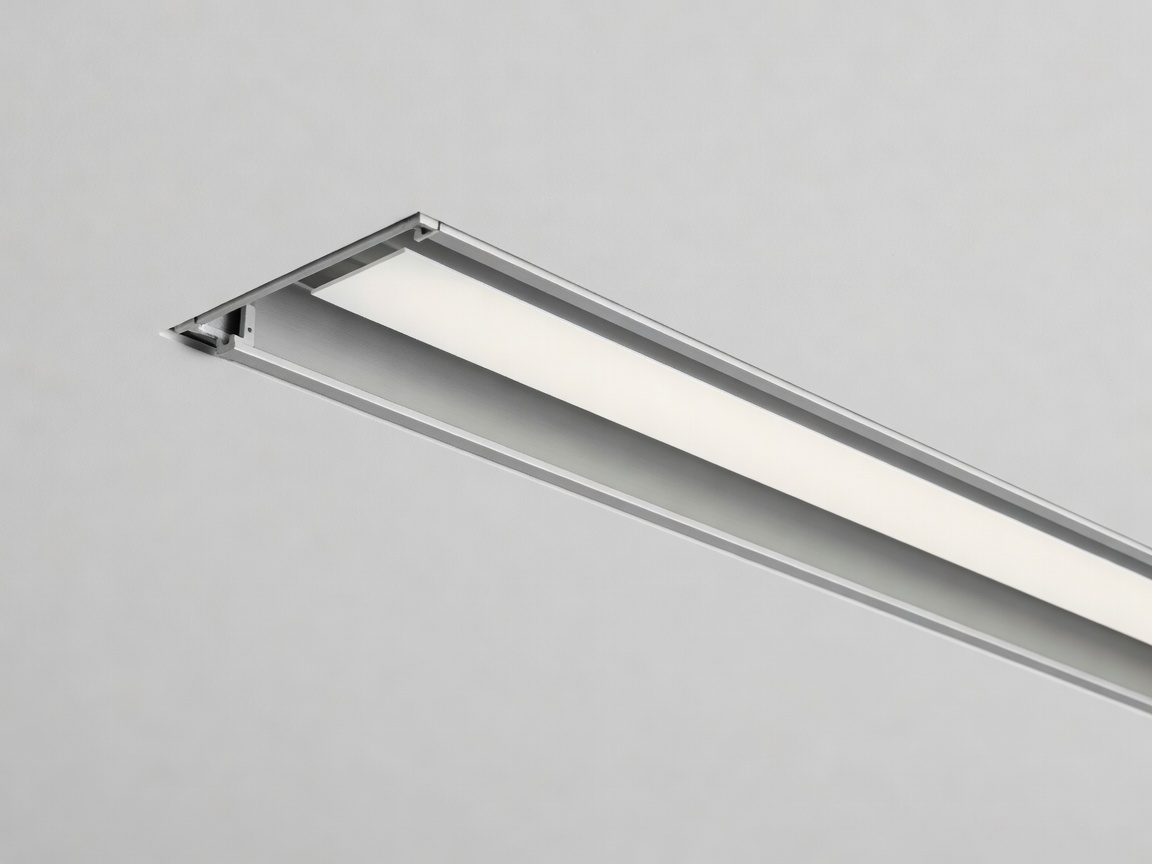
The Belgian Doctrine of Invisible Illumination
Contemporary Belgian architectural lighting fundamentally rejects fixtures that call attention to their own mechanical enclosure. Over the past three decades, designers working out of industrial design hubs in Roeselare and Antwerp have championed the philosophy of "light, not luminaires." The ultimate realization of this tenet is the trimless linear aluminum profile: a channel engineered to vanish completely into drylined ceilings and partition walls.
When properly installed, an observer standing beneath a continuous linear profile perceives only an uninterrupted stroke of balanced luminance or a subtle gradient washing down a perimeter wall. There are no metal overlap flanges, no visible fasteners, and zero mechanical intrusion upon the purity of the ceiling plane.
Anatomy of Precision Extrusions: Alloys and Thermal Management
Achieving optical uniformity across 20-meter linear ceiling runs requires strict manufacturing tolerances. Belgian extruders predominantly utilize architectural-grade 6063-T6 aluminum alloy. This material offers the optimal balance between tensile strength—preventing sagging or bowing across long suspended or recessed spans—and superior thermal conductivity (approximately 200 W/m·K).
High-output phosphor-converted LED tapes emitting 1,800 to 2,800 lumens per meter generate localized junction heat. Without an engineered heatsink channel, operating junction temperatures exceed 85°C, triggering phosphor decay and noticeable chromaticity shifts (delta u'v' > 0.005) within eighteen months. Belgian profile sections feature dual lateral thermal fins extruded directly into the back-channel, maintaining diode operating temperatures below 60°C in ambient room temperatures of 25°C.
Diffuser Optics: Opal Polycarbonate versus Micro-Prismatic Louvers
Selecting the appropriate optical cover dictates both the aesthetic softness and the visual comfort of the installation. Belgian manufacturers provide two primary optical configurations:
- Satin Opal Polycarbonate (UGR ~22–24): Extruded with embedded light-diffusing titanium oxide nanoparticles. These diffusers yield an immaculate, dot-free line of light with a Lambertian distribution (110° beam). They are ideal for perimeter corridors, decorative ceiling reveals, and mood lighting, but can induce visual fatigue if used directly over computer workstations.
- Micro-Prismatic PMMA & Dark-Light Louvers (UGR < 19 / < 16): Precision micro-structures combined with matte black or high-reflectance specular aluminum mini-cells. The optical cutoff shields direct view of the diode array beyond 35 degrees from vertical, channeling output precisely downward onto task planes without ceiling glare.
| Profile Category | Aperture Width | Shielding Angle | Typical Efficacy | Target Application |
|---|---|---|---|---|
| Micro-Trimless Recessed | 16 mm – 22 mm | 40° Deep Cutoff | 85 – 105 lm/W | Residential corridors, gallery reveals, minimal hospitality |
| Architectural Slot System | 35 mm – 50 mm | 35° Micro-Louver | 115 – 135 lm/W | Commercial boardrooms, executive desks, premium retail |
| Perimeter Grazing Cove | 65 mm – 100 mm | Asymmetric Wall-Wash | 95 – 120 lm/W | Textured stone walls, drapery pockets, vertical expanses |
Specification Trade-offs: Advantages and Disadvantages
Architectural Advantages
- Absolute Cleanliness: Flangeless mud-in profiles merge seamlessly into drywall with zero shadow lines.
- Continuous Run Capability: Internal connector pins and light-tight overlapping diffusers eliminate dark end gaps.
- Exceptional Color Quality: High CRI (95+ Ra, R9 > 80) across 2700K, 3000K, and tunable-white ranges (2200K–5000K).
- Control Protocols: Native compatibility with DALI-2, 0-10V, and wireless Casambi mesh networks.
Engineering Challenges
- Demanding Drywall Coordination: Requires meticulous drywall framing tolerances (±1 mm); substandard plastering results in visible hairline cracks.
- Remote Gear Accessibility: Drivers must be sited in accessible technical cupboards or above ceiling access hatches.
- Initial Capital Cost: Belgian profile systems carry a premium compared to generic aluminum channels due to tighter alloy tolerances and optical engineering.
Installation Best Practices and Commissioning
When specifying trimless recessed linear extrusions, contractor sequencing is critical. The aluminum profile framework must be anchored to structural ceiling framing before the final layer of 12.5 mm or 15 mm plasterboard is applied. Perforated wings on the extrusion are coated with joint compound and covered with non-woven fiber reinforcement tape to prevent expansion-induced cracking.
Power feeds should be calculated to prevent voltage drop over runs exceeding 8 meters on 24V DC systems; dual-end feeding or intermediate 48V-to-24V step-down converters are standard practice for long Belgian atelier-grade installations.
Specify Architectural Profiles for Your Project
Connect with our atelier team for optical beam calculations, CAD detail libraries, and physical extrusion sample kits.
Request Profile Specification Kit